 +1 (774)478-6704
 Order@premiumonebackdrops.com



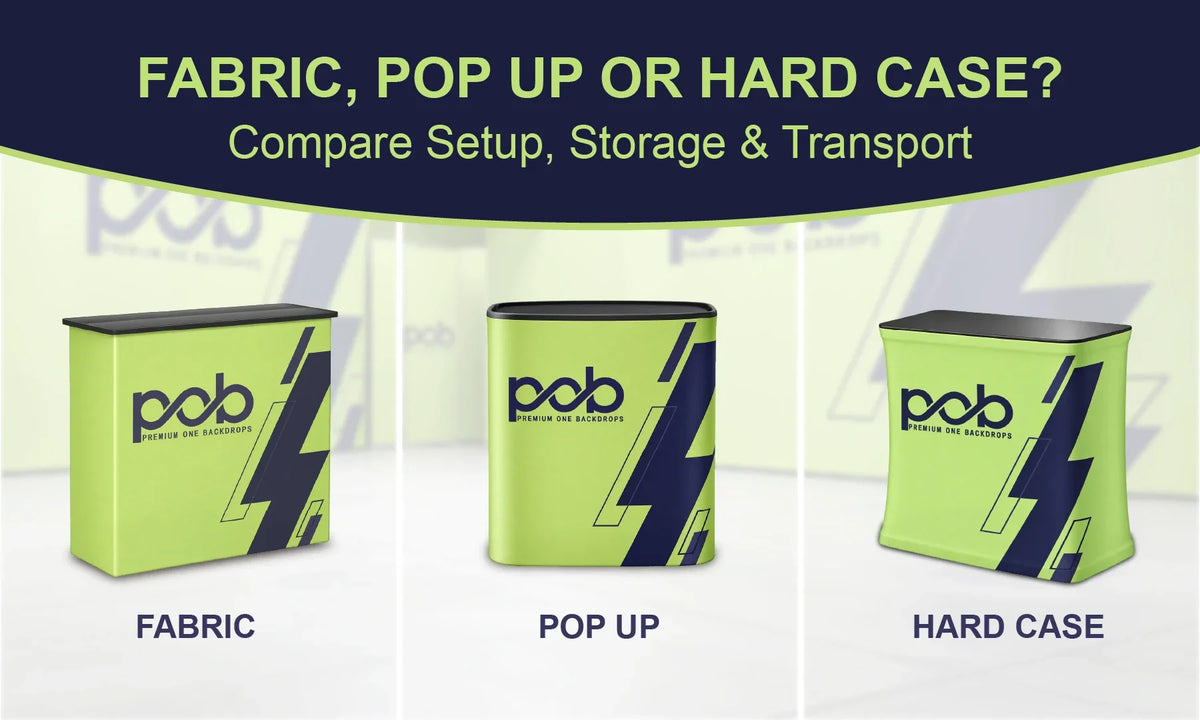
Fabric counters, pop up counters, and hard case podiums can all create a branded interaction point at a trade show, but they are built for very different event routines. The most useful comparison is not simply which one looks better. It is how the frame works, how the counter is assembled, what can be stored inside, how it packs after the show, and whether the structure also serves a transportation purpose.
Looking at those differences makes it easier to understand why counters with a similar finished size can perform very differently once your team starts setting up, storing supplies, breaking down, and traveling between events. You can browse the available options in our Counter & Podium Displays Collection as you compare the structures below.
Fabric Counter vs. Pop Up Counter vs. Hard Case Podium: Structure Comparison
| Counter Type | Frame / Structure | Storage | Packing & Transport | Best Fit |
|---|---|---|---|---|
| Fabric Counter | Lightweight aluminum frame with fitted fabric graphic | Varies by model; some shapes do not include internal storage | Disassembles into smaller components and packs into a carry bag | Lightweight branded interaction areas |
| Pop Up Display Counter | Collapsible aluminum frame that expands into position | Internal storage available on the selected model | Frame collapses down for repeated packing and transport | Working counters for brochures, samples, and event supplies |
| Hard Case Trade Show Podium | Molded protective case converted into a branded podium | Interior used to transport compatible exhibit components | Wheeled hard-shell transport system | Frequent exhibitors traveling with display hardware |

Fabric Counters Use a Lightweight Modular Frame
POB fabric counters are built around lightweight aluminum framing and a fitted fabric graphic. The structure is assembled into the finished counter shape, then broken down again after the event. This keeps the packed system relatively compact compared with a rigid shipping case.
For example, the Round Fabric Counter uses an aluminum tube frame with separate top and base components and a stretch fabric graphic. Once the event is over, the parts are disassembled and packed instead of remaining as one rigid structure.
The exterior shape does not tell you everything about the internal structure. A round or oval counter may be designed mainly as a branded presentation surface, while another model may provide more usable internal space.
Shape is therefore a separate decision from frame type. Round, oval, square, and triangle counters can affect visitor approach, countertop area, and footprint in different ways. If you are comparing those shape differences, see our Round vs. Oval vs. Square vs. Triangle Fabric Counters: Which Shape Fits Your Space?.
Pop Up Counters Change the Setup and Storage Routine
The Pop Up Display Counter uses a collapsible frame instead of separate tubular sections. The frame expands into position for the event and collapses again for packing, which changes both the setup process and how the counter is handled between shows.
Its more important difference is the internal working space. Brochures, samples, giveaways, and other frequently used booth materials can be kept inside the counter instead of taking up countertop space.
This makes the structure useful when staff actively work from the counter throughout the event. A reception point that only needs a branded surface may not need this additional structure, while a check-in or sample station can benefit from having supplies nearby.
When comparing it with a fabric counter, look at the frame, internal layout, graphic attachment, and packed configuration rather than focusing only on the printed surface.
Hard Case Podiums Are Built Around Transportation
The Hard Case Trade Show Podium starts from a different design idea. Instead of creating a display that then needs to be packed inside another case, the hard shell itself forms part of the transportation system.
Compatible booth components can be stored inside the case during travel. At the venue, the same case is converted into a branded podium using the countertop and graphic wrap. After the show, it returns to its transportation role.
That makes its function very different from a lightweight fabric counter. The hard case is heavier and bulkier because protection during transport is part of the product design. Integrated wheels help with movement, but vehicle space, loading access, and venue handling still need to be considered.
For exhibitors who regularly move larger display systems between venues, this dual-purpose structure can be more useful than minimizing packed weight.

Installation Is Different Because the Frames Are Different
The installation process follows the structure of each counter. A fabric counter requires the frame components to be connected before the graphic and countertop are fitted. A pop up counter relies on opening and securing the collapsible frame before the remaining components are added.
A hard case podium follows a different process again. The transportation case becomes the counter body, so setup is more about converting the case into its display configuration than assembling a lightweight frame from separate sections.
For teams attending several events, this difference matters. A structure that can be assembled, packed, and moved consistently may be more practical over time than one chosen mainly for appearance.
Storage Means Something Different for Each Counter
“Storage” does not mean the same thing across all three structures. With a pop up counter, storage usually means keeping brochures, samples, giveaways, or booth supplies accessible during the event.
With a hard case podium, the internal space is more closely connected to transportation. It helps carry compatible display hardware and other exhibit components between locations.
Fabric counters should be checked model by model. An enclosed fabric graphic does not automatically mean there is a shelf or usable storage compartment behind it. The internal frame determines how much space is actually available.
Choose Based on the Event Routine, Not Just the Finished Look
A fabric counter makes sense when the priority is a lightweight branded structure that can be broken down into compact components. A pop up counter is more useful when the counter also needs to function as an active working station with supplies nearby.
A hard case podium becomes more relevant when transportation is part of the problem you are trying to solve. Instead of using one product as a shipping case and another as a counter, the same structure can perform both roles.
If you are still deciding more broadly which type of counter fits your booth activity, footprint, and event setup, read our How to Choose the Right Trade Show Counter or Podium for Your Booth for a wider buying overview.
Compare the Frame Before You Compare the Graphic
The most important differences between these POB counter models are underneath the printed surface. Check how the frame opens or assembles, whether usable storage is included, how the product packs, and what role the structure plays during transportation. Those practical differences usually matter more across repeated events than small visual differences between counter styles.
If you are still unsure which counter structure fits your event, contact the POB team with your booth size, planned counter use, transportation needs, and event date. We can help you compare suitable options before you order.