 +1 (774)478-6704
 Order@premiumonebackdrops.com


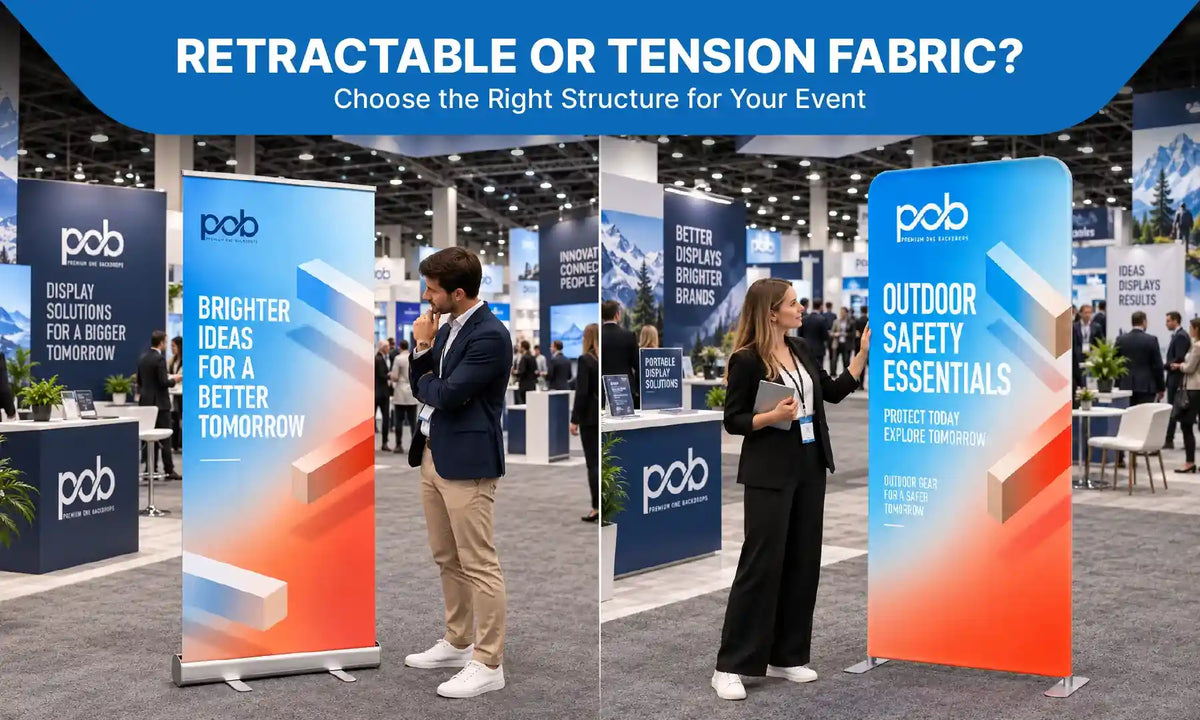
Retractable banner stands and tension fabric banner stands are both portable display options, but they work differently once you bring them into an event space.
A retractable banner is built around quick setup and a compact vertical message. A tension fabric banner uses a lightweight frame and fitted fabric graphic to create a larger branded surface. The better fit depends on where the display will be used, how often it will move, and what you want visitors to see.
What Is a Retractable Banner Stand?
A retractable banner stand, also known as a roll up banner, stores the printed graphic inside its base. To set it up, you position the base, connect the support pole, pull the graphic upward, and secure it at the top.
This simple structure is one of the main reasons retractable banners are commonly used at conferences, reception areas, retail promotions, event entrances, and smaller trade show spaces. They work particularly well when the display needs to communicate one focused message without taking up much floor space.
A product launch, for example, might use a retractable banner for a product image, short headline, and QR code. At a conference entrance, the same format can be used for event branding or directional information.
Our Budget Roll Up Banner is one example of this type of portable display for events, offices, and promotional spaces.
What Is a Tension Fabric Banner Stand?
A tension fabric banner stand uses an aluminum tube frame covered by a fitted fabric graphic. Once installed, the fabric stretches across the structure to create a smooth display surface with minimal visible hardware around the graphic.
Compared with a retractable banner, this format gives the design more room to work with. Larger photography, brand colors, product graphics, and other visual elements can become a stronger part of the display rather than being limited to a narrow vertical panel.
A Portable Tension Fabric Banner Stand can also work naturally alongside a larger backdrop or counter, making it useful when you want several pieces in the booth to share the same visual style.
Depending on the product configuration, tension fabric displays may also offer single- or double-sided graphics, which gives you more flexibility in open event spaces.
Retractable Banner vs. Tension Fabric Banner: Key Differences
| Feature | Retractable Banner | Tension Fabric Banner |
|---|---|---|
| Structure | Graphic rolls into the base | Fabric fits over an aluminum frame |
| Setup | Pull-up setup with support pole | Frame assembly and fabric installation |
| Graphic Area | Narrow vertical format | Larger fabric display surface |
| Appearance | Visible base and vertical graphic | Smooth fabric with minimal visible hardware |
| Typical Use | Entrances, promotions, conferences | Trade show booths and branded spaces |
| Viewing Options | Primarily front-facing | Single- or double-sided depending on model |

How Setup Differs Between Retractable and Tension Fabric Banners
Setup is one of the clearest differences between the two systems.
A retractable banner is designed to go up quickly. Once the support pole is in place, the graphic pulls directly from the base. This makes it convenient when one person is handling setup, when several displays need to be installed at once, or when the banner regularly moves between locations.
The graphic also retracts into the base after use. It should be guided back carefully rather than released suddenly, which helps protect both the printed surface and the internal mechanism.
A tension fabric banner takes a few more steps. The frame sections need to be connected before the fabric graphic is fitted over the structure. In return, the hardware becomes less noticeable once the display is assembled, leaving the fabric itself as the main visual surface.
If setup speed is the priority, the retractable system has a clear practical advantage. If the finished graphic area matters more than saving a few setup steps, the fabric system may suit the space better.
Artwork for Retractable vs. Tension Fabric Banner Stands
The two formats also call for different approaches to graphic design.
A retractable banner has a tall, narrow layout, so the message needs a clear hierarchy. Branding is usually most effective near the upper portion where it remains visible from a distance, followed by a headline, key visual, and a limited amount of supporting information.
It is also worth remembering that tables, people, or other objects may block the bottom of the banner. Contact information or a QR code should be positioned where visitors can still see and use it.
A tension fabric banner gives you more visual space, but that does not mean every part of it needs to be filled. Larger photography, stronger use of brand colors, and simpler text can often make better use of the wider fabric surface.
If you are building a coordinated booth, you can also carry the same artwork style across your Tension Fabric Displays, banner stands, and other display pieces.
Portability and Storage for Banner Stands
Both displays are portable, but they pack in different ways.
With a retractable banner, the printed graphic remains inside the base during storage and transportation. This protects the graphic without requiring it to be removed after every event. The trade-off is that the base remains a rigid part of the packed display.
A tension fabric banner breaks down into smaller frame sections, while the fabric can be removed and folded separately. This makes the hardware easy to pack, although the fabric should be kept clean and dry before storage.
If your team travels frequently and needs to set up in different locations, think about the complete routine rather than packed size alone. Who carries the display, how often it is assembled, and how much time is available at each venue can matter just as much as the dimensions of the package.
Single- and Double-Sided Banner Stand Options
Viewing direction matters when comparing the two formats.
Retractable banners are primarily used as front-facing displays. This works well against a wall, beside a booth, near an entrance, or anywhere visitors approach mainly from one direction.
A tension fabric banner can provide more flexibility when a compatible double-sided option is available. If the stand sits in an open area or between two sections of a booth, graphics on both sides can make use of visitor traffic coming from different directions.
Do not assume that every banner can simply be converted from single- to double-sided use. Check the product configuration before ordering so the frame and graphic are designed for the intended setup.
Which Banner Stand Works Better for Your Event Setup?
The decision becomes easier when you start with the role the banner needs to play.
If it is mainly there to communicate one message—such as a promotion, event direction, QR code, or product introduction—a retractable banner keeps the setup simple. It is especially useful when the display moves frequently or needs to be installed by one person.
If the banner is a more visible part of the booth design, a tension fabric system gives you additional graphic space and a fabric finish that can coordinate with larger backdrop displays. It can also make more sense when both viewing directions matter.

For other portable formats, you can compare more options in our Banner Stand Collection.
Retractable vs. Tension Fabric Banner FAQs
Which Is Better, a Retractable Banner or a Tension Fabric Banner?
They are designed for different uses. Retractable banners prioritize fast setup and a compact vertical format, while tension fabric banners provide a larger fabric graphic area and more flexibility for booth-focused branding.
Is a Tension Fabric Banner Harder to Set Up?
It involves more assembly than a retractable banner because the frame sections and fabric graphic need to be installed separately. The process is still straightforward once you are familiar with the frame.
Can I Replace the Banner Graphic Later?
Replacement options depend on the display system. A new graphic needs to match the exact frame model, size, and attachment method, so confirm your existing hardware before ordering a replacement.
Do I Need a Double-Sided Banner Stand?
Only if both sides will be visible. A front-facing display against a wall usually does not need a second printed side, while an open booth or aisle location may benefit from graphics facing both directions.
Can Retractable and Tension Fabric Banners Be Used in the Same Booth?
Yes. They can serve different purposes within one setup. A tension fabric display can carry the main booth branding, while a retractable banner can highlight a product, promotion, QR code, or specific message nearby.
Find the Banner Stand That Fits Your Setup
The main difference is not simply fabric versus roll-up construction. It is how each display functions within the event space.
A retractable banner keeps setup fast and the message focused. A tension fabric banner gives the graphic more presence and can become a stronger part of the overall booth design.
Explore the POB Banner Stand Collection to compare portable display options for trade shows, conferences, promotions, and branded events.