 +1 (774)478-6704
 Order@premiumonebackdrops.com



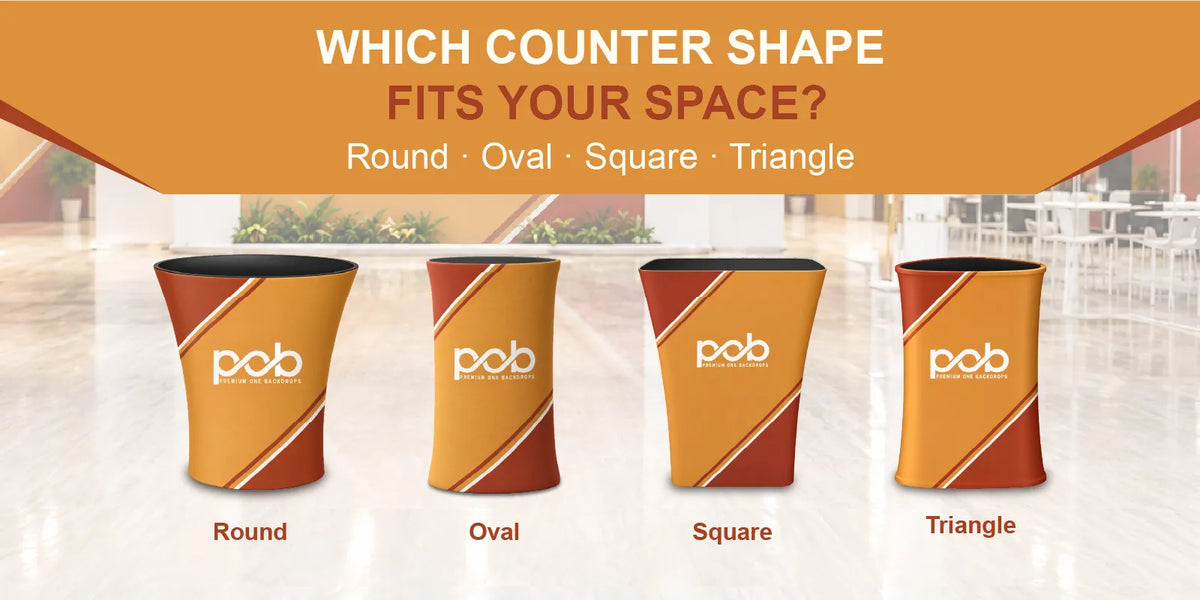
Round, oval, square, and triangle fabric counters can look similar in product photos, but their footprints and usable top surfaces are not the same. The most useful comparison is not simply whether one shape looks more compact or provides more workspace. Those decisions should be based on the actual dimensions of the specific POB counter and how its top-view footprint fits into your booth.
Before choosing a shape, compare the counter width, depth, countertop profile, visitor approach, and the direction the main graphic will face. The table below uses current POB model dimensions so you can compare the four shapes from the same starting point.
Round vs. Oval vs. Square vs. Triangle Fabric Counters
| POB Counter | Size | Top-View Footprint | What to Check |
|---|---|---|---|
| Round Fabric Counter | 2.6ft / 1.3ft diameter × 3.3ft H | Circular footprint | Confirm which diameter option you are using before comparing floor space or countertop area |
| Oval Fabric Counter | 2ft W × 1.3ft D × 3.3ft H | 2ft × 1.3ft oval footprint | Compare its narrower width and rounded ends with the items you plan to place on top |
| Square Fabric Counter | 2.6ft W × 1.3ft D × 3.3ft H | 2.6ft × 1.3ft rectangular footprint | Check whether the longer straight edge is useful for your countertop layout and booth position |
| Triangle Fabric Counter | 2ft W × 2ft D × 3.3ft H | 2ft × 2ft triangular footprint | Compare the angled usable top area with the full 2ft maximum width and depth |
Use the Actual Dimensions Before Comparing Shape
A shape name alone does not tell you which counter uses the least booth space. The POB Oval Fabric Counter measures 2ft wide by 1.3ft deep, while the Square Fabric Counter measures 2.6ft wide by the same 1.3ft depth. The Triangle Fabric Counter reaches 2ft in both width and depth, and the Round Fabric Counter is available with listed diameter options of 2.6ft or 1.3ft.
That means the comparison should start with the exact model and size option. A round counter is not automatically the smallest, and an oval counter is not automatically the largest working surface. Width, depth, and usable countertop shape all matter.

Round Fabric Counter: Compare the Diameter First
The Round Fabric Counter uses a circular countertop and continuous curved graphic surface. POB currently lists diameter options of 2.6ft and 1.3ft, with a height of 3.3ft.
Those two diameter options create very different footprints, so the selected size needs to be confirmed before comparing it with the other shapes. A 1.3ft diameter counter takes up much less floor area than a 2.6ft diameter version, even though both are described as round fabric counters.
The circular top can work well for one tablet, a sample tray, or a featured product placed near the center. If you need to line up several rectangular brochures, boxes, or devices, however, the curved edge may affect how efficiently the surface can be organized.
Oval Fabric Counter: 2ft Wide × 1.3ft Deep
The Oval Fabric Counter measures 2ft wide by 1.3ft deep and 3.3ft high. Its top-view footprint is therefore relatively shallow from front to back while keeping a wider horizontal presentation area.
That specific proportion can be useful where booth depth is limited, but it should still be compared with the actual objects you plan to place on the countertop. The curved ends reduce the usable rectangular area compared with a straight-edged surface of the same maximum width and depth.
The curved graphic also affects artwork placement. Your main logo should face the strongest visitor approach rather than simply sitting in the center of the artwork template. For more guidance on logo hierarchy, messaging, and graphic layout, see our Trade Show Counter Design Guide: What Should You Put on the Graphic?.
Square Fabric Counter: 2.6ft Wide × 1.3ft Deep
The Square Fabric Counter measures 2.6ft wide by 1.3ft deep and 3.3ft high. Its maximum depth is the same as the oval model, but it extends farther horizontally.
The straight front and side edges can make it easier to organize rectangular items such as brochures, tablets, boxes, or a card reader. They also create clearly defined graphic faces that can align naturally with straight booth walls and other rectangular display elements.
However, the 2.6ft width means it requires more horizontal space than the 2ft-wide oval model. Whether that extra width is useful depends on your booth layout and how much countertop space your team actually needs.
Triangle Fabric Counter: 2ft × 2ft Maximum Footprint
The Triangle Fabric Counter measures 2ft wide by 2ft deep and 3.3ft high. From above, it fits within a 2ft × 2ft maximum footprint, but the usable countertop is triangular rather than a full square surface.
That distinction matters when comparing working space. The counter may occupy 2ft in both directions, but the angled sides reduce the usable surface compared with a 2ft × 2ft square countertop.
The three-sided structure also creates more directional graphic faces. One face can be turned toward the strongest aisle approach, while the others support secondary branding or product messaging.
Compare the Top View, Not Just the Product Photo
A top-view comparison makes the footprint differences much clearer. The Oval Fabric Counter is 2ft × 1.3ft, while the Square Fabric Counter is 2.6ft × 1.3ft. Both have the same depth, but the square model uses an additional 0.6ft of horizontal space.
The Triangle Fabric Counter uses a 2ft × 2ft maximum footprint, giving it more depth than the oval and square models. The Round Fabric Counter varies significantly depending on whether you select the 1.3ft or 2.6ft diameter option.
These dimensions are more useful than assumptions such as “round is more compact” or “oval gives more workspace.” The exact model, selected size, and countertop shape determine how much room the counter actually uses.

Plan Space for People Around the Counter
The footprint is only the starting point. A counter also needs room for the staff member using it and for visitors to stop without blocking the booth entrance. Place the counter footprint on your booth plan, then add the surrounding working and visitor space before deciding where it should sit.
If you are planning around a standard exhibit footprint, our Trade Show Counter Size and Placement Guide for 10×10 Booths covers counter clearances, visitor flow, staff space, and placement in more detail.
Choose the Shape From the Dimensions and Use
Choose the counter by combining its actual footprint with what needs to happen on the countertop. The 2ft × 1.3ft oval model uses less horizontal width than the 2.6ft × 1.3ft square model, while the 2ft × 2ft triangle uses more front-to-back depth. The Round Fabric Counter can vary considerably depending on whether you choose the 1.3ft or 2.6ft diameter option.
After checking the dimensions, compare the usable top shape and the graphic faces visitors will see from the aisle. If you are still unsure which counter fits your booth, contact the POB team with your booth size, planned counter position, and the items you need to place on the countertop.